


The Real Reason DFW Commercial Parking Lots Fail Early — And What to Do About It
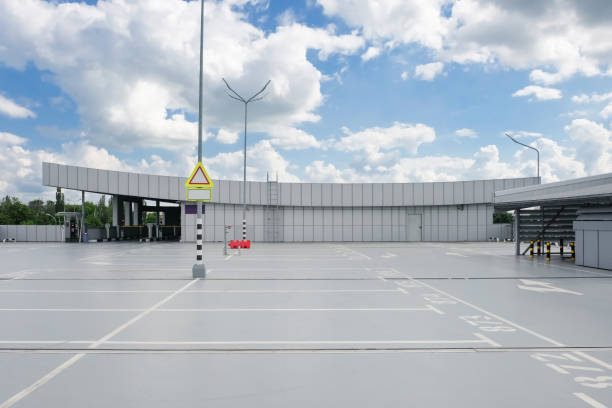
Walk the parking lots of any commercial corridor in Fort Worth, Keller, or Grapevine and you'll see the same story repeating at property after property. Asphalt that was fine two summers ago now has a network of cracks spreading from every high-stress point. A low corner that collects water after every rain and doesn't drain properly. Ruts forming in the traffic lanes where delivery trucks slow down and turn. Edge deterioration creeping inward from every perimeter where the base has started to give way.
The owners of these properties are not negligent. Most of them sealcoated on schedule, patched when cracks appeared, and did what they were told to do to maintain the investment. The problem isn't the maintenance. The problem is that asphalt commercial parking lots in the DFW climate are fighting conditions they weren't designed to win against — and the maintenance cycle that's supposed to extend their life is ultimately just slowing down an outcome that was built in from day one.
<cite index="471-1">Parking lots in Dallas live a tough life: triple-digit summers, clay-heavy soils, and constant traffic from shoppers, tenants, and delivery trucks.</cite> That combination — extreme heat, reactive soil, heavy loading — is exactly where asphalt's material properties are most exposed. Understanding why DFW parking lots fail faster than their projected lifespan is the first step toward making a commercial paving decision that actually serves the business long-term.
What's Actually Happening Under a Failing DFW Parking Lot
Surface cracks and ruts are symptoms. The actual problem is almost always one of three things happening beneath the surface — and in North Texas, usually more than one at once.
The clay soil is moving and the base isn't stopping it.
<cite index="471-1">The clay-heavy soils across the Dallas-Fort Worth region create significant challenges for any paved surface.</cite> Tarrant County and Dallas County clay expands measurably when it absorbs moisture from heavy spring rains, then contracts and pulls away from structures during the prolonged summer drought that follows. This cycle repeats multiple times a year — and it applies the same upward, downward, and lateral pressure to the base of a commercial parking lot slab that it applies to every other concrete or asphalt surface in the region.
For asphalt specifically, this movement is particularly damaging because asphalt relies on its flexibility to accommodate ground movement. In moderate climates with stable soil, that flexibility is an asset. In DFW's reactive clay, it means the surface bends and deflects constantly under both soil pressure from below and vehicle loads from above — with no rigid structure holding it in place. The result is progressive fatigue cracking that originates not from the surface but from below, spreading upward and outward until surface patching no longer addresses where the failure is actually occurring.
The heat is softening the surface under load.
This is the factor that separates DFW from most commercial paving markets in the country. <cite index="448-1">Concrete is better suited for hot climates, as it stays cooler and is resistant to softening or warping under intense sunlight.</cite> Asphalt, by contrast, is a petroleum-based material that loses rigidity as temperature rises. In North Texas, sustained temperatures above a hundred degrees Fahrenheit are not occasional events — they're the predictable reality of June, July, and August. During those months, the surface temperature of a dark asphalt parking lot can reach a hundred and forty degrees or higher.
At those temperatures, asphalt under slow-moving vehicles — delivery trucks decelerating into loading areas, garbage trucks turning around at collection points, heavy commercial vehicles stopping in traffic lanes — develops ruts. The surface deforms under load because the binding agent holding the aggregate together has softened enough to allow movement. Patching ruts in an asphalt lot during a DFW summer is a short-term solution because the conditions that created the ruts are still present every day for three months of the year.
The drainage was never right to begin with.
<cite index="120-1">Every small detail in parking lot design can make or break the final product's safety, efficiency, and longevity.</cite> Drainage is the most consequential detail and the most frequently underengineered. A commercial parking lot in DFW that doesn't actively direct water away from the lot surface and away from the building foundation is a lot that's being damaged every time it rains.
Standing water on asphalt infiltrates the surface, reaches the base, saturates the clay soil beneath it, and accelerates the expansion cycle that causes base failure. Standing water at the perimeter of a commercial property can migrate toward building foundations and create problems that are orders of magnitude more expensive than a parking lot replacement. And in DFW, where intense spring storms regularly drop two to four inches of rain in a matter of hours, the drainage design has to be engineered for actual North Texas rainfall — not average conditions.
Why Concrete Changes the Math for DFW Commercial Properties
The case for concrete in DFW commercial parking lot construction isn't complicated. It comes down to what happens when you take the three failure mechanisms above and apply them to a rigid concrete slab instead of flexible asphalt.
Clay soil movement under concrete. A properly engineered concrete slab with adequate base preparation, subgrade stabilization, and rebar reinforcement throughout doesn't deflect under soil pressure the way asphalt does. It redistributes the load across the slab as a unified structural element, holding together through the same clay movement cycles that progressively fatigue asphalt. <cite index="121-1">A concrete parking lot can last forty years or even more and has the ability to accommodate heavy vehicles, large trucks, RVs, and dense traffic.</cite>
Heat performance. Concrete doesn't soften. Regardless of surface temperature, a concrete parking lot maintains its structural rigidity under load. There is no temperature threshold in North Texas weather — including the most sustained heat events on record — at which a properly poured concrete slab develops ruts under vehicle loads the way asphalt does. This alone makes concrete the rational material choice for DFW commercial properties with delivery traffic, service vehicles, or any loading scenario that puts repeated concentrated loads on specific surface areas.
Long-term cost. The upfront cost of concrete commercial paving is higher than asphalt — typically by thirty to fifty percent on a per-square-foot basis. That differential is real and it's the primary reason asphalt remains common in the DFW commercial market. But the total cost of ownership over a thirty-year holding period tells a different story.
<cite index="117-1">Asphalt parking lots generally need resurfacing once every twenty years and resealing roughly once every two to four years. Concrete parking lots generally need to be resealed once every three to five years and require resurfacing every fifteen to twenty years.</cite> That maintenance cost differential — compounded over the life of a commercial property — typically closes the upfront gap between materials and often reverses it. A DFW commercial property owner who builds once in concrete and maintains it appropriately will almost certainly spend less on their parking lot over a thirty-year period than one who builds twice in asphalt with ongoing maintenance costs in between.
Beyond direct cost, there are operational costs that are harder to quantify but real. Every asphalt repair cycle means cones, signage, partial closures, contractor scheduling, and disruption to the businesses and tenants whose customers use the lot. A concrete lot that doesn't need that maintenance cycle every eighteen months is a lot that doesn't create those operational costs.
What a Properly Built DFW Commercial Concrete Parking Lot Actually Requires
Understanding what separates a commercial concrete lot that delivers its projected lifespan from one that underperforms is the foundation of any productive conversation with a contractor.
Subgrade stabilization for North Texas clay. Standard residential base preparation — excavation and compacted gravel — is the starting point. Commercial applications in DFW clay typically require an additional step: lime stabilization of the top six to eight inches of reactive clay soil before any base material is placed. Lime reacts chemically with clay to reduce its plasticity and improve its bearing capacity, directly reducing the magnitude of the expansion and contraction forces that reach the slab above it. This is a standard specification for commercial concrete work in DFW — not an upgrade.
Engineered slab thickness based on anticipated loads. Standard passenger vehicle lots are typically designed at five to six inches of concrete thickness. Mixed-use lots with regular delivery truck access need six to seven inches. Heavy commercial vehicle routes — loading dock approaches, trash compactor pads, fire truck access lanes, industrial use areas — require eight to twelve inches with heavier reinforcement designed for point load concentrations. A contractor who quotes every commercial lot at the same thickness without discussing actual load conditions is not engineering the project correctly.
Rebar at the right size, spacing, and depth. Commercial parking lot reinforcement is not a question of whether to use rebar — it's a question of specifying the right bar size and spacing for the loads the lot will carry. That specification should come from the engineering drawings, not from a contractor's default practice. Rebar placed correctly in the middle third of the slab, tied properly at intersections, and supported off the subgrade so it doesn't sink during the pour — this is the structural work that holds a commercial slab together when North Texas soil moves beneath it.
Control joint design for large-footprint slabs. Commercial parking lots involve large concrete areas that will expand and contract with every temperature cycle DFW delivers. Control joints placed at calculated intervals in both directions — typically fifteen to twenty-five feet depending on slab thickness and load conditions — give the concrete designated locations to manage that movement without random uncontrolled cracking across the lot surface. Joint placement on a commercial lot needs to be planned before the pour, not improvised during finishing.
ADA compliance designed in from the start. Federal ADA standards require a specific ratio of accessible parking spaces based on total lot capacity, with precise dimensions for accessible spaces and access aisles, compliant slopes, and accessible routes connecting parking to building entrances. Retrofitting ADA compliance after a lot is built is significantly more expensive and disruptive than designing it correctly from the beginning. Every commercial parking lot project in DFW should include ADA layout review as part of the design phase.
Permitting through the right municipality. Commercial parking lot construction requires building permits in Fort Worth, Keller, Southlake, Grapevine, North Richland Hills, and every other DFW municipality. The submittal requirements — site plans, drainage calculations, ADA documentation, engineering drawings — vary by city. A contractor familiar with DFW municipal permitting will handle this as a standard part of the project scope, not as a complication.
The Questions Every DFW Business Owner Should Ask Before Signing a Parking Lot Contract
Most commercial property owners who end up with underperforming parking lots made their contractor decision primarily on price. The bid that came in thirty percent lower than the others was appealing — and the reasons for that gap only became clear a few years later when the lot started failing in ways a properly built one shouldn't.
Before committing to any commercial concrete contractor in DFW, the right questions are:
Will the subgrade be lime-stabilized? In North Texas clay, this is best practice for commercial applications. A contractor who doesn't address subgrade stabilization is leaving the most consequential step out of the scope.
What slab thickness are you specifying, and is it based on actual load analysis? The answer should reflect where delivery vehicles will be operating, where heavy equipment might access the lot, and where concentrated loads will occur. A single thickness across the entire lot footprint is often not the right engineering answer.
How are you sizing and spacing the rebar, and how will it be supported during the pour? Vague answers about standard reinforcement are not sufficient. Specifications should be in writing.
Who handles permit applications and ADA compliance documentation? A professional commercial contractor handles both. A contractor who asks the property owner to manage permitting is creating unnecessary risk and delay.
What is your drainage plan and where does the water go? The contractor should be able to walk a site and describe specifically how water will be directed off the surface and away from the building. If the answer is vague, the drainage design hasn't been done.
CBD Concrete: Commercial Parking Lots Across DFW
CBD Concrete is a locally owned, family-operated concrete contractor serving Fort Worth, Keller, Southlake, Colleyville, Grapevine, and the greater Dallas-Fort Worth Metroplex. Owner Dane manages every commercial project directly — coordinating site engineering, permitting, subgrade preparation, pour scheduling, and ADA compliance with the same hands-on accountability he brings to every project regardless of scale.
Every commercial lot CBD Concrete pours starts with the subgrade work that North Texas clay demands. Lime stabilization where required. Engineered slab thickness based on actual load conditions. Rebar at the right specification, placed correctly. Control joints planned before the pour. Drainage designed for real DFW rainfall.

If you manage or own a commercial property in Fort Worth, Keller, Southlake, Grapevine, or anywhere in the DFW Metroplex and need a new parking lot or are dealing with one that's failing — CBD Concrete will assess the site and give you a free, detailed quote with straight answers about what the project actually needs.
Get Your Free Commercial Lot Quote → cbdconcrete.com/contact


